How Can We Help?
Explanation
Explanation
We live in a society, which generally requires an explanation for the things we do or are engaged in. This particularly applies to professional practice in this field in which explanations are commonly given to the client and relevant others about their problems and any advice, suggestions and interventions we may have to offer.
The Law appears to the view that practitioners should be able to explain themselves and their actions, if not to the client then at least to colleagues, peers and the Courts.
It is important for the practitioner to provide an explanation to the client about their problem and to connect this explanation to the course of action reached in the therapeutic process.
The explanation about the ‘problem’ does need to connect to the explanation about intervention; it should traverse the general domain set out by the request, contract and problem assumes a certain ‘social and relational field’ of relevance; and it should be a carefully constructed statement by the practitioner to the client and relevant others about the request, contract and problem and any other matters of concern.
The explanation about the request, contract and problem is a short speech, a statement made in the grand tradition of rhetoric; a statement designed to engage the hearts and minds of all parties relevant to the request, contract and problem, either directly or indirectly; it is a statement specifically designed to be influential and to have the relevant parties to the request, contract and problem see the ‘problem’ and the other issues from the practitioner’s point of view. This is not necessarily a statement designed to disqualify or negate the opinion or perspective of the client or any other party to the matter. In fact skilled practitioners are able to incorporate other perspectives into their own much larger and more flexible meta-perspective.
Probably the most difficult matter to explain is the positive relationship that almost invariably exists between the ‘problem’ and the ‘social and relational field’; that the status quo appears to have some merit to it despite the obvious negative consequences for some of the people involved.
Explaining
The BPM engages in five therapeutically and philosophically profound activities in relation to the problem, these being:
- Naming
- Describing
- Explaining
- Meaning
- Turning
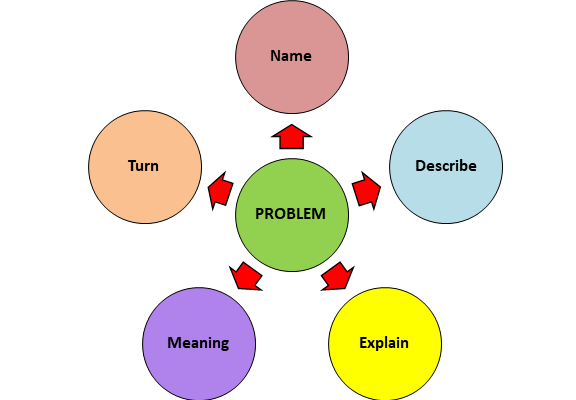
The common practice of psychotherapy, i.e. changing a ‘problem’ or turning a problem around, ordinarily locates understanding at the centre of its process. Understanding is a complex process. It is fair to suggest that some form or parts of understanding are usually associated with all forms of psychotherapy.
The common practice of psychotherapy, i.e. changing a ‘problem’, can achieve its central objectives in four ways as follows:
- Understand the ‘problem’ and change it;
- Change the ‘problem’ and understand it;
- Change the ‘problem’ without understanding it;
- Understand the ‘problem’ and not change it.
Turning
The task of psychotherapy is to turn the ‘problem’ around or to turn the person or people with the ‘problem’ around or away from the ‘problem’.
The idea of turning is fundamental to the practice of psychotherapy.
Psychotherapy struggles to find its legitimate place in that space between the literal and the figurative for so long dominated by philosophy, poetry and religion; all natural bedfellows to this activity called psychotherapy.
What does this problem mean? Of what relevance is the meaning to the problem we adduce, impose or avoid?
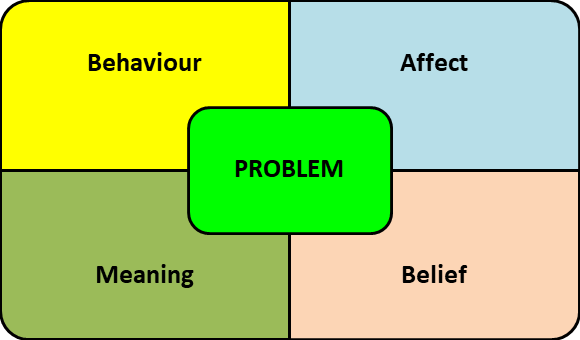
There are models of therapy that focus on the literal, the event itself, the behaviour, the emotions, the actual thought patterns and processes, and the relationship.
Other models focus on figuration, the meaning of the event, the meaning of the behaviour, the meaning of the emotions, the meaning of the thought patterns and processes, and the meaning of the relationship. Of course the further removed we are from the actual behaviour or interaction the further we drift into the world of meaning and cognition; the turning world; the world of turning; the world that ascribes meaning to the event, the behaviour, the interaction and the emotion. This is the world that turns from the literal to the meaning ascribed to the literal. Many would argue that it is not possible to behave, interact or emote without cognition. Others observe wryly that many people give no thought to their actions.
A psychotropic drug is a drug that turns the psyche, the mind. What does it turn?
A medically prescribed psychotropic drug turns the mind that hears the sounds and voices that other people don‘t hear; sounds and voices from within and not from without. A psychotropic drug turns the mind away from those sounds and voices; it shuts down those sounds and voices; it turns them off.
There are psychotropic drugs that are not medically prescribed.
The Bower Place Model & Explanation
1. Two explanations are better than one.
2. An explanation should conform to the law of parsimony – Occam’s Razor – cut the cr..!
3. An explanation should draw a clear distinction between constraint and conventional causation (i.e. negative explanation versus positive explanation)
4. Constraint offers a better explanation under most circumstances, in relationship to most matters involving human beings (i.e. a. did not cause b. to happen in the way that it did).
5. A written explanation is quite different to a verbal explanation – a verbal explanation must be delivered – means the conventional rules about verbal delivery need to be taken very seriously indeed
6. The primary task of an explanation is to ‘make a difference’ – what is the point in offering an explanation that does not ‘make a difference’ – that difference must be apprehended by the person or people offered the explanation, usually about a problem, symptom or a dilemma – if that person or people cannot apprehend the information contained in that explanation as being different then you will not make any difference with this explanation (i.e. the information must not only instruct the person or people concerned, but it must also perturb them)
7. Get the distinction between instruction and perturbation clear – if an explanation as instruction fails to perturb then that instruction is largely pointless. An explanation delivered so it has maximum opportunity to instruct and maximum chance to perturb is critical when dealing with complicated and complex problems and their circumstances. The explanation must perturb first and instruct later – not the other way around.
8. Instruction is similar to conventional causation, whereas perturbation is genuinely negative explanation – a single event can perturb six different people in six entirely different ways – perturbation can open the way for sage instruction.
9. Explanation delivered in a way that perturbs, usually has many of the characteristics of theatre - delivery, pacing, pausing, volume, intonation, pronunciation, etc.
10. A good explanation is also delivered in multiple forms of word and image communication, verbally, in writing, multi-coloured, physically, in diagrammatic form, contemporaneously, and later.
11. The major issue in all service delivery is the citizen/consumer/client/patient being able to remember and process the information provided by the practitioner. If the client et al cannot remember the information then they will be unable to process that information – means the information must be presented in a form that perturbs the client in such a way that they will remember they were perturbed, and why, and what it was that perturbed them (i.e. the explanation)
12. The art of explanation – is the art of the practitioner delivering that explanation – requires of the practitioner extraordinary control over themselves, over their own body, their voice, over their use of language, pronunciation, speed with which they speak, hands and hand movements, how they sit, in a chair, cross their legs, their arms, hold their belly, wave their arms, around, or point or fidget or touch their face or move their feet, and so on and so forth.
13. The art of explanation requires that the practitioner decide where they sit in relationship to the client or clients, the actual physical distance between themselves and those people – closeness and distance matter – moderated by other forms of proximity.
14. The art of explanation requires the practitioner make a decision about eye contact, and it’s value in delivering an explanation that perturbs – as an expression of inequality it is of doubtful value in explanation - perhaps Freud was right after all!
15. The self-discipline of the practitioner is critical to the effectiveness of an explanation and its potential to perturb.
16. Practitioners for whom English is not their first language, must learn how to take advantage of their first language in the therapeutic/service delivery process; and inject their first language into that explanation process. Words and phrases in a different language carry slightly different meaning. Take advantage of this inexorable slippage across language and languages. Make use of your own clumsiness in English as your second language, to draw the client into you, into assisting you, into participating with you in that explanation process.
17. An explanation should be written, spoken, drawn, and possibly physically represented, all in the one move and moment, the still point of the turning world, to give that explanation maximum chance of perturbing the client or clients et al.
18. The explanation should travel with the client or clients, way beyond the direct encounter with the practitioner who did the explaining, way beyond the clinic and that therapeutic encounter. Many clients cannot process the information on the spot and require some considerable length of time to come to grips with the explanation. This is in the nature of the psychometric differentials that define us as functionally unequal.
19. A robust explanation covers all four points in the Bower Method - time, space, development and politics – this is especially so in complicated and complex matters – that is what we do for a living – that is – “if you call this living” (old Russian joke)
20. The art of pulling together time, space, development, and politics into a parsimonious explanation or two that perturbs takes considerable personal and linguistic dexterity on the part of the practitioner – requires endless, unremitting, practice.
21. It is a wise and prudent idea on the part of the practitioner, when confronted with unfamiliar material, to write it out, dot points on a page, as if you are making a speech to the familiar – conform to the rules of speech making – each line has one point – each image stands alone and for itself
22. Every decent explanation carries one or more significant metaphor – it is a wise idea to learn thoroughly the art of analogy, in particular metaphor, and the central role analogy as metaphor plays in thinking and explanation, perturbation and the ‘making of a difference’. Analogy is central to being human. Explanation stripped of analogy is not human. Cognition is collective carried by the analogies that connect us as the umbilical cord once did – carries oxygen to the blood.
23. Explanation is integral to the therapeutic intervention process that also includes some aspects of description, advice, and the recommended actions or strategies that follow from all of this.
24. Therapeutic practice has long been conceptualized as a strategic process, with recommendations about the positive courses of action available to remedy a problem, symptom, or dilemma. The positive strategies that often follow a robust explanation diminish, are largely inappropriate and flawed.
25 A robust explanation should point all parties in the direction of cessation – ‘cutting the crap’ – that which creates the emotional, cognitive, psychological, relational, and behavioural space into which something good and right and decent can occur – that is us.
26. It is inappropriate for the practitioner to impose themselves upon this psychological and relational space that appears out of cessation – snuffs out spontaneity – control is reserved for the down side.
Rhetoric
“…the art of effective or persuasive speaking or writing, especially the exploitation of figures of speech and other compositional techniques”
“…language designed to have a persuasive or impressive effect, but which is often regarded as lacking in sincerity or meaningful content”