How Can We Help?
Difference Questions
The Difference Question
This is the bower(note) template for the difference question in systemic practice one of the basic tools of enquiry in contemporary systemic practice. The question must conform to the protocols or conventions of syntax, it must be parsimonious and reverberate with, and perturb, the person or people on the receiving end of the question. The question is, generally, more designed to perturb and less designed to instruct which is in the interventive nature of the question.
The Portable Difference Question
Bower(note) carries three types of question.
a. Questions that gather general information e.g. name, age, etc.
b. Questions that explore the dimensions and details of the problem/symptom and its circumstances e.g. details of time, duration, location, behaviour, and interaction in relationship to the problem/symptom.
c. Questions that explore change in relationship to the problem/symptom and its circumstances e.g. interaction, behaviour, relationships, emotions, and cognition, at those times when the problem/symptom or some the circumstances are not, or may not, be present.
All three types of question are necessary and involve a particular form of interaction and engagement with the client, relationship system, and/or family.
Questions that explore changes in relationship (C) involve the highest order of skill, which requires the practitioner to work with ‘difference’ and ‘perturbation’, to apprehend difference as it occurs, to propose difference, to create difference, to work with difference, and to amplify difference because difference is the driver of change.
Learning to Ask a Question
The practitioner must master the art of conceiving, constructing, and asking a question and this must be done for all three types of question.
Category a. is a list, it is the straightforward gathering of information.
Category b. requires knowledge about the construction of a question.
Category c. is an elaboration of the skill set required for Category b. and requires an elaborate knowledge of ‘cessation’ as these are primarily questions about the absence of something rather than the presence of something, questions about the problem/symptom and its circumstances coming to a halt. This also requires an elaborate knowledge of problem/symptom formation, the relationship between neurobiology and social organisation, causation and constraint, instruction and perturbation, inclusion, exclusion and inequality, difference, and the translation of these into the syntax of a sentence, a question, that can perturb.
The first task in this process is for the practitioner to learn how to ask a question, and develop the dexterity required to transform that question from one that simply gathers information into one that can perturb. We need a therapeutic process in which the practitioner is as perturbed by the client, as the client is perturbed by the practitioner. This goes some way toward remediating the order of inequality endemic to the therapeutic process. We know that inequality in any form is one of the fundamental constraints and impediments to change.
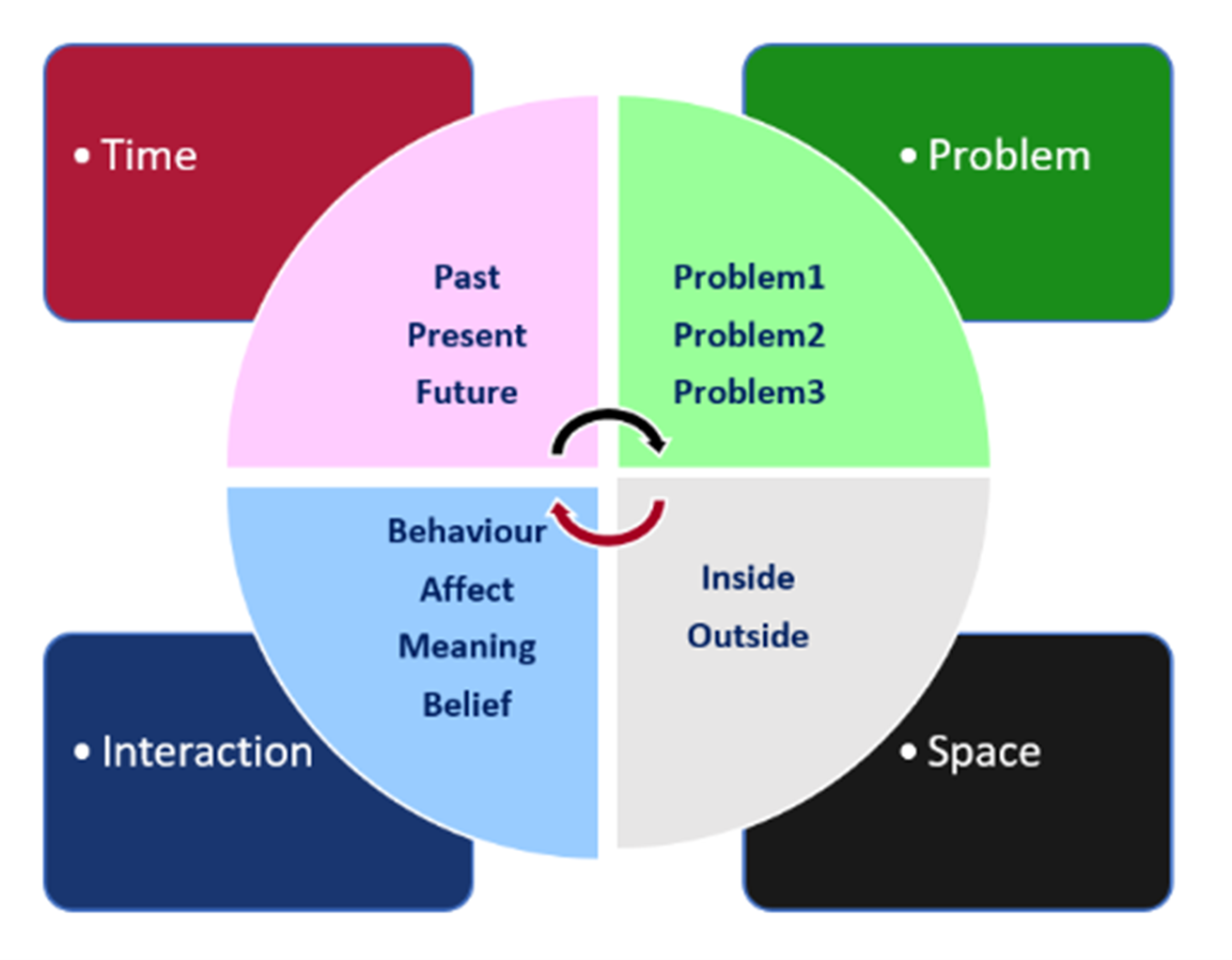
A simple question must always be constructed in four parts which are:
- Interaction [behaviour- affect – meaning – belief]; in relationship to
2. A [problem/symptom]; located on
3. The [inside or outside]; at particular point in
4. [time past – time present – time future].
The skilled practitioner is able to manipulate and move the question around to imply difference, and such difference as created by the practitioner, may well perturb and produce change.
Creating Momentum through Questioning
If the basic structure of the first question is –
[behaviour] + [problem/symptom1] + [inside] + [time present]
Cognitive dexterity in the therapeutic relationship, can be achieved by shifting one variable at a time, so the second question may be structured as follows, changing ‘behaviour’ to ‘affect’ –
[affect] + [problem/symptom1] + [inside] + [time present]
And the third question may be structured, moving from time present to time past
[affect] + [problem/symptom1] + [inside] + [time past]
And the fourth question may be structured, moving from the inside to the outside, as –
[affect] + [problem/symptom1] + [outside] + [time past]
Then the practitioner may return to a focus on behaviour –
[behaviour] + [problem/symptom1] + [outside] + [time past]
If we imagine there is more than one problem/symptom, the next move may be to shift the focus onto problem 2 so that becomes –
[behaviour] + [problem/symptom2] + [outside] + [time past]
Each move implies difference, a difference implied by the sequence. There are a massive number of permutations, even if we limit the number of problems to three or four, which is common in complex, comorbid, matters.
This can now be represented as a set of words on a page, a piece of written syntax, and it can also be represented visually, as a diagram, for example as axes with four quadrants, or a square, rectangle or oblong, 4 sides, each side representing one of – interaction, space, time, and the problem/symptom(s). We can now go to the other lines and progressively increase the complexity question, by adding one line at a time. There is an astonishing array of possible questions that can be put in a therapeutic process, and the fact that the practitioner alone, or the practitioner in collaboration with the client(s), must make critical decisions about which questions to exclude. It is not possible to ask every question in this matrix, in the time available in any therapeutic process.
This is, to some degree, about clinical judgement but it is not unreasonable to suggest that such clinical judgement will always be informed by the ‘theory of change’ from which the practitioner/agency works. It may be possible to classify ‘theories of change’ in such a way as to moderate this matrix. The interactional, developmental, spatial, and temporal, characteristics of each ‘theory of change’ would most likely achieve that end. It is distinctly possible that an insight, inside, and past oriented ‘theory of change’ would self-select those temporal and spatial variables, and exclude any outside, and future oriented variables, effectively slicing the matrix in half.