How Can We Help?
Managing an Adolescent Eating Disorder: Case Study 2
Overview – Presenting Problem/Request of each party
Miranda was 14 years old and worried. She said that she was ‘struggling with body issues’ and ‘the way I look and eat’. She reported a distressing cycle of eating too much, gaining weight, and then stopping eating in order to lose weight. She spoke of this taking up all her brain space, so she was unable to study and prevented her wearing clothes she liked to wear and spending time with friends because of how she looked.
At the first session her request was to help her lose weight and feel good about her appearance. She believed this could best be done with the support of a personal trainer and she wanted help to convince her mother to join a gym. Her mother’s request was to ‘help Miranda’.
Social System presenting to session
- Miranda
- Miranda’s mother
Social system relevant to case – ecogram
- Miranda
- Miranda’s mother & father
- Friends
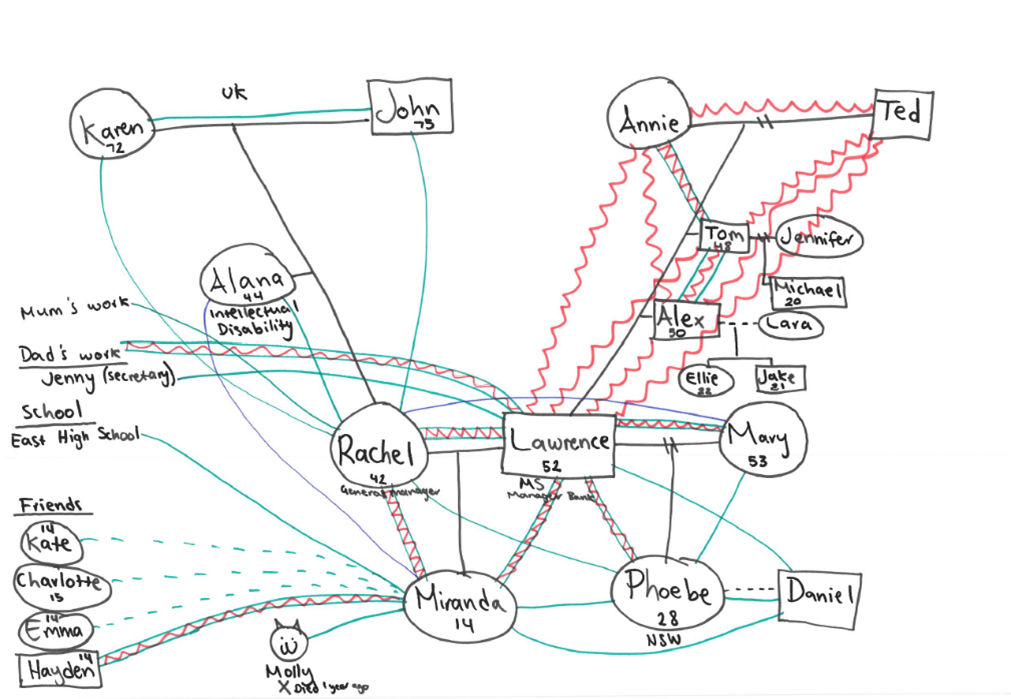
Analysis using Bower Place Model
Authority and Responsibility
The central issue around authority and responsibility revolved around each family members locating the resolution of relational problems within themselves and the use of substances to address the distress they experienced. In effect no-one took ownership of the matters between them and hence these were never explored or redressed. This was in contrast to the appearance of Miranda taking responsibility for her weight and size.
There was also a struggle between Miranda and the practitioner, with Miranda being clear about how the issue was to be resolved and initially not accepting other advice.
Inside/Outside
Miranda spoke of being possessed by thoughts of size and weight and how she could resolve the problem of being ‘too fat’. This disconnected her from friends and made it difficult to concentrate on schoolwork. She said she was sad and worried most of the time.
On the outside Miranda had become increasingly disconnected from friends who she perceived as not wanting her to join them. She also avoided social events as she was unable to resist eating snacks which would then trigger an episode of overeating.
She lived alone with both her parents who she said had never been happy together. While she did not conflict with either parent she would often find herself invited to ‘take sides’ in their arguments, a role she resisted by spending increasing time in her bedroom. It was here that she would eat snacks to comfort herself. Both parents worked long hours and conflict would often erupt over the timing and preparation of the evening meal.
Miranda’s mother Rachel had not been close to her mother who had failed to protect her from an abusive father. She wanted to be close to Miranda but felt awkward and uncertain as to how to reach out to her daughter. Her father, Lawrence suffered from MS, but refused to acknowledge that his health was deteriorating and would not discuss the matter with either wife or daughter. Lawrence would comment on his daughter’s weight and size but would take her shopping and buy her sweets which she would eat in secret in her room.
Both parents used alcohol to avoid each other and the distress in their lives. Sometimes this would be the focus of conflict with each accusing the other of being alcoholic.
Miranda had an older half-sister, Phoebe who had been an important person in her life. Phoebe was her father’s child from his first marriage and was 14 when Miranda was born. She had lived with the family until Miranda was 7 and then had moved out of the house to live independently in the same city. However, the year before she had left to live interstate with her new partner. Phoebe had been the person Miranda had turned to when she was distressed, and she felt her absence keenly. While they kept in touch by phone Miranda found she could not confide in her sister as she once had done.
Time
While Miranda had always experienced her parents as unhappy and argumentative, this had escalated as her father’s health had deteriorated. She found herself increasingly inveigled into their conflict and distanced from both to avoid this as she loved them both.
In time past Miranda had been less aware of her parent’s conflict and her father in particular had been less inclined to implicate her. As a younger child, Rachel had been more confident in their relationship and reported feeling closer to Miranda but in adolescence just ’didn’t know what to do’.
Miranda had always had a close group of friends and would spend a significant amount of time at their homes. However recently she reported feeling excluded and barely tolerated by the group and had distanced herself in consequence.
The loss of Phoebe, her older sister had been particularly difficult as Miranda now had no-one to talk to about her struggles. An additional and significant loss was that of her dog, who had been a major source of comfort.
All family members avoided discussion of time future as this included the future deterioration and ultimate death of Lawrence. Rachel was clear that, despite everything she would care for Lawrence through his illness but could not bring herself to imagine what this would mean for her.
Miranda had a vague sense that she would go to university but, like her mother was unwilling or unable to imagine a relational future.
Development
All family members development was constrained by the unspoken fears of Lawrence future. All lived in the
Miranda had always had a strong productive identity and was considered clever. However, she was finding concentration on school work increasingly difficult as she became increasingly concerned about her weight.
Her peer identity had also been strong but this too was beginning to falter as she avoided social events.
Sexual identity had also been developing with a recent relationship with a boy in her class. She reported he was supportive but her increasing concern about her appearance was beginning to dominate their time together.
While there was a strong attachment identity this too was troubled with the conflict and distress of her parents being run through Miranda
Constraints
The major constraint in this matter was the use of substances to avoid addressing painful and intractable problems. Miranda’s father Lawrence suffered from MS which was becoming increasingly debilitating. While he continued to fulfill his senior role in a large corporation, he only did so with the support of his long time secretary who covered for his mistakes and the days he was unable to be at work on time. He refused to speak with his wife or daughter about his illness and maintained the belief that it did not affect his functioning as father and husband.
Miranda’s mother, Rachel also worked long hours in a senior position and struggled to fulfill the role of wife, mother and worker. She attempted to protect both her husband and daughter from the implications of his illness and in doing so was often in conflict with Lawrence. She had decided to ‘keep her moth shut’ to avoid overt conflict and to do this would drink excessively.
A second major constraint was the social isolation of the family. Lawrence had ‘escaped’ from his highly abusive and controlling family at 14 and had no contact with his family members. Rachel had emigrated to Australia as a young adult and while she maintained telephone contact with her elderly parents and sister, who had an intellectual disability, said she did not like to worry them with her troubles. They believed that she was happy and successful, and she did not want to spoil this.
While the family had made some friends through work these relationships had been strained by the tension between the couple which would sometimes become apparent with Lawrence verbally attacking Miranda and asking others to support his stance.
Advice
The problem timeline allowed a diagrammatic explanation of the situation. By showing Miranda that the eating disorder had started at a time when her world had grown ’thinner’; her old dog and confidante had died, her sister had moved interstate to pursue her career, the boy she had hoped for a relationship with had rejected her and her friends were less available, she could see this was not simply a matter of exercising more effectively. The metaphor was developed to explain that as her world had grown thinner, she found herself cold and lonely. As there appears to be no solution she had tried to alter the one thing over which she had control, her body. This made her lonelier and hungrier as she increasingly focussed on her body and neglected her world. To address the problem, she needed to ‘fatten’ up her world rather than trim her body to size.
With Miranda’s permission I asked that we shared this understanding with her mother and suggested that she begin to grow her world with what she had, not what she did not have. I asked that Miranda and her mother first strengthen their relationship and used this to support Miranda to go out into the world. This may include going to a gym but this was only a small part of a much bigger solution.
Explanation given to client
The graph was used to present a different explanation for Miranda’s difficulties and hence different solution. It showed that Miranda had managed her parent’s conflict successfully with the support of Phoebe, her dog, and her friends and that the family solution to difficulties, avoidance, had worked well for her. However, with the loss of her sister and pet and distancing from friends she had nowhere to hide from the distressing matters in her life that could not be spoken about. Instead she had turned to the only thing left she believed she could control, her body. Unfortunately, this would only result in her becoming more isolated and not solve the problem.
Unique theoretical analysis of key presenting issue
The making of the graph to demonstrate a new understanding of the difficulty was central to this case. Instead of arguing with Miranda about the efficacy of her solution, going to the gym, the production of the timeline side stepped this and made it evident that this solution was not sufficient. It provided a completely different metaphor to explain the genesis of the problem, her world had become too ‘thin’ to support her to manage the difficulties in her home life and proposed a different solution which reconnected mother and daughter while moving Miranda into time future.