How Can We Help?
Therapy and Management of Violent Children and Adolescents
The Bower Place approach to working therapeutically with out of control and violent children and adolescents requires that the parent, practitioner, family or agency grasp of a few fundamental propositions about practice.
Space and Time
All human problems are located in space and time; and how we think about or conceptualize space and time in relation to any child or adolescent behavioural difficulty and violence will directly determine the direction we take with these problems, the direction we take with the people implicated in these problems, and the intervention strategies we use to produce change.
Theory and Strategy
How we think determines what we do; and how we think is premised upon the theory we use; and the theory we use will always be spatial and temporal i.e. about space and time; and this may also imply other ideas or theories about justice, the body, partnership and responsibility. Strategy is what we do.
Spatial Analogue
Please note that there is no method, model or practice in the helping and human services field that does not use a spatial analogue i.e. that locates problems and their solutions somewhere in actual or conceptual space. The most common spatial analogues are ‘inside-outside’, ‘inclusion-exclusion’, ‘front-back’ and ‘surface-deep’.
Analogue
An analogue is a figure of speech, similar to metaphor, that simply says that this event or experience is like something else e.g. when we say that a child ‘is as angry as a lion’ we don’t for one moment believe that the child is a lion or the embodiment of a lion, or that the child’s anger is the lion’s anger. An understanding of analogue is central to understanding the Bower Place approach to working therapeutically with out of control and violent children and adolescents. Analogue provides the theoretical lens through which to see the problem and a way to think about the problem; it allows us to say that the out of control/violent child or adolescent is like this this or that; and the ‘this or that’ is in terms of space and time.
The ‘Inside-Outside’ Spatial Analogue
All child and adolescent ‘out of control’ behaviour and violence can be understood, in the first instance, through the lens of the ‘inside-outside’ spatial analogue. The words ‘inside’ and ‘outside’ are ordinary, common, words in everyday usage; not highbrow; not technical or medical words. According to Hofstadter, all words, including common words such as ‘inside’ and ‘outside’ are in fact analogies or analogues of something else; that language itself is an analogue of experience, be that our experience of ourselves, events, objects or each other. I am particularly taken by the use of common words such as ‘inside’ and ‘outside’, not as a way of dumbing down a complex, sophisticated, idea; but as a way of elevating the dialogue about this. The use of complex words and language allows for an order of abstraction not permitted by words such as ‘inside’ and ‘outside’; and I am interested in avoiding such abstraction as it creates inflexibility in the model. Words such as ‘inside’ and ‘outside’ allow for a level of intellectual flexibility and linguistic dexterity that a more complex use of language does not appear to permit. I am interested in the apparent proximity of the literal with its analogue when words such as ‘inside’ and ‘outside’ are used. We experience ourselves physically as having an ‘inside’ and an ‘outside’ and to that end this is the language that is with us in every moment of every day. Of course it is also true that the words ‘inside’ and ‘outside’ describe our experience of ourselves; and this experience may only be that; our experience; and that our experience may not be entirely true; may not be literally true. If we go into the world of particle physics, the fact that this is our physical experience of ourselves becomes so much more true; especially as we understand this we are mostly space and this physical experience is primarily electromagnetic. What appears true at one level may not be true at the next; and we have a language that tells us, describes to us, what our experience of ourselves and the other, the world is. This is not mere sophistry! There is a very important point to all of this and that is in relation to child and adolescent ‘out of control’ behaviour and violence. This is a thorny problem and one that is difficult to think our way into without being waylaid by the certitudes of language and morality. In this I am searching for a language free of religion, dogma and ideology; and I find this in the use of common words, words like ‘inside’ and ‘outside’ and other such words as are used in this text; ‘front–back; ‘surface–deep’; ‘inclusion-exclusion’; and ‘turning’; and so on and so forth. I want words where the distinction between the literal and its linguistic analogue appears so close and simple that we are afforded an unnerving level of simplicity, flexibility and dexterity consistent with the requirements of cognition itself. For what it is that I am pursuing with such parsimony is the relationship between the parts of the analogue i.e. the relationship between the ‘inside’ and the ‘outside’; how the ‘inside’ and the ‘outside’ connect, articulate and feed off each other; inform each other; invent each other; and so on as the analogue dances to its own tune. For my central proposition is that the parsimony offered by the ‘inside’ and ‘outside’ spatial analogue allows us to genuinely witness the recursive relationship between the ‘inside’ and the ‘outside’; a recursion that is linguistically more difficult to apprehend the more abstract our language. Words in everyday use offer up the parsimony required for the cognitive dexterity required to apprehend recursion. And what is recursion but the way the world is arranged so that each part of the analogue invents the other part of the analogue in repeating endless feedback loops that fuel themselves. Enough! We are ahead of ourselves! This is the ‘turning’ we seek; the parsimony that is the clarity of vision that sees the way the world turns and it is only truly evident to us, such ‘turning’ that is, when the world does not turn the way it should turn in our experience; for the most fundamental experience of ‘turning’ is the earth’s rotation on its own axis; and should that stop or even slow we are all dead. The turning that is this recursion that is wholly analogic is in fact life itself. And my entire hypothesis is that such recursion in the analogue is precisely where the pathologies of human existence lay; the violence in an out of control life or world is understood in terms of this recursion; that the ‘inside’ of the violent adolescent is recursively reinforced and invented by the ‘outside’ which in turn reinvents the ‘inside’ and so on. Let me go on!
‘Inside’ Neurobiological
The ‘inside’ spatial analogue refers to the neurobiological system of the person; their brain and nervous system; the neural loops in their brain; their biology, physiology and biochemical make up. This includes their biological development.
‘Outside’ Socio-relational
The ‘outside’ refers to the socio-relational world of the person; this is the world of transforming attachment; this is the world the person differentiates into and in relation to; and this is the world of human exchange and interaction.
Village
All people require a village and we usually acquire a village just by existing; it may not be the most desirable village, but it is a village nevertheless.
· Inclusion-Exclusion
· Front-Back
· Surface-Deep
· Partnership
· Authority & Responsibility
· Justice
· Time
There is no method, model or practice in the helping and human services field that does not use a temporal analogue i.e. locate the problems and their solutions somewhere in time: Time past, time present & time future
· Mirroring
· Fragmentation & Fracture
· Request & Contract
· Process
If we are asked to change a child’s behaviour, if we want to give this child, these parents, this teacher, a chance to turn this behaviour, emotions, situation, mind, relationships around we need to engage with three basic activities being:
Description
We need to have a basic description of the child and their behaviour before we attempt to do anything about it, to turn it. Describe the behaviour, child, parents, patterns, emotions, cognition, interaction etc.
Understanding causes before strategy. Of course you will need to have a strategy for managing the out of control behaviour of the child; but to be affective with the out of control child you will need to know why you are using the strategy; what affect it is likely to have etc of particular importance is to look at the most important question: How will this strategy make a difference, because unless we actually believe that this strategy will make a difference then we are not only wasting time BUT we may also be making the situation worse; making the child worse; we may be ‘hurting’ the child more through a well-meaning but misguided strategy.
Naming
Name the problem, behaviour, emotions, neural loops, interaction, cognition, relationship etc. We need to put it into a category of some kind; a category we can give a name to; and a name we can organise and share with others.
Explaining
Explain the behaviour, emotions, child, relationships, interaction etc described and named; and this explanation is about causation and context; what has caused this problem and this child or adolescent to be the way they are; and what are the circumstances that make it possible for these causal processes to take effect.
Ordinary, for an explanation to be satisfactory we need at least two + lines of causation plus one line of context. One line of causation does not usually cut it; is not an adequate explanation for a serious child or adolescent problem.
Turning
This is the process of change. This usually requires some form of action or cessation.
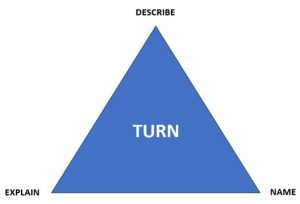
And we go round and round in circles, describing, naming and explaining until we are satisfied (emotionally and intellectually) that we are in a position to have a go at turning the situation around.
If you can’t describe it and name it is very hard to explain it or turn around a complicated situation like child or adolescent aggression and violence.
Verbal & Visual Techniques
You need to have some basic grasp of what is happening in the ‘head’ and the ‘heart’ of the aggressive, violent, uncontrollable child. This requires a rudimentary understanding of the neuroscience of how the brain really works generally, and ain the child. The basics are as follows; we all have a brain, we all have a front brain and we all have a back brain. The brain has evolved in humans over hundreds of thousands of years; and it has evolved from when we were reptiles to now, not in some orderly fashion but in a higgledy- figgeldy fashion. So here is what I want you to do as you read this. Take your right hand and wrap your right hand around your forehead until you can feel your brain throbbing underneath; under your right hand is your ‘front brain’ the latest and newest part of the brain (in evolutionary terms) and this front brain, the throbbing and pulsating you can feel your thoughts and ideas and reasoning doing its business, these are your frontal lobes thinking away, using language and numbers, working things out. Now drop your right hand and raise your left hand around the lower back part of your head. Got it! OK. Now feel into the deepest senses of your brain down there. This is your ‘back brain’; the oldest part of the brain (in evolutionary terms) some refer to this as your old ‘reptilian brain’, a reference to a time long ago when we were reptiles; or so they say!! And the pulsating and throbbing your feel under your left hand, these are your emotions stirring the pot, down there in your Limbic System, in your, Hippocampus and in particular your Amygdala. The big words don’t matter much for your purposes. Common words like ‘back’ brain and ‘front’ brain will do…. they help us understand something quite profound, that is for some reason the location of things appears important to humans when they attempt to explain things.
The name ‘Amygdala’ does not mean much to most people whereas ‘front’ and ‘back’ brain do; they locate something for us and location appears to have some explanatory value for us; the words ‘front’ and ‘back’ locate the brain and its functioning in space and space appears to be a primary way we as humans think. Enough of this sophistry. ‘Front’ and ‘back’ will do and do better than all the sophisticated words neuroscience has to offer. The real story here is in how the front and back brain work together. And it is not rocket science to work out that in violent, aggressive, uncontrollable children the ‘back’ brain and the ‘front’ brain don’t work too well either separately or together, that there is something amiss here in the head of the child; that the ‘old back brain’ emotions are stirred up or out of control or that the ‘front’ brain isn’t or can’t do its business managing the rampart ‘back’ brain; or maybe the now ‘front’ brain just ain’t up to the task; no matter; however we look at this, something to amiss; the ‘back’ is too fired up; the ‘front’ is not up to it; or the link between the two doesn’t work all that well.
So now we have the guts of a hypothesis about violent, aggressive, uncontrollable children. This is an inside the head hypothesis and most people stop here believing they have described enough to name it and explain it. NO! This is not enough. As it said earlier, a good and useful explanation requires 2+ lines of causation and some analysis of the context or circumstances that make it possible for these lines of causation to do their stuff.
So there it is…point 2. “Front’ and ‘back’ brains; new and old brains; reason and emotion; while part of the brain runs the show, emotion or reason; it’s not rocket science in matters where the child is violent, aggressive, uncontrollable; back brain emotions; fear, anger and the amygdala, run the show!!
Not to labour the point too much, but the neuroscience of the ‘front’ and ‘back’ brains is a compelling part of the story and one simple fact underscores the differential between the ‘front’ and ‘back’ brain. The ‘front’ brain is fully mature at 24 in women and 26 in men. Why is that? But it does go some way to explaining the apparent differential maturity of young men and women. And the ‘back’ brain, the Amygdala; the Hippocampus; the Limbic System, 85% fully mature by the age of four. How about that! So there is a 20-22 year ago gap between the old ‘back’ brain and maturing the new ‘front’ brain maturing. That means the ‘back’ brain is alive and well and doing its emotional business a long time before the ‘front’ brain is ready to handle it, to handle and manage the ‘back’ brain. And managing the ‘back’ brain is one of the major tasks of the ‘front’ brain.
This may be particularly significant for boys as compared to girls. The devil, as always, is in the detail; and the detail is compelling. To say that the ‘old back brain’ is the site of emotions is easy. But what we know is what we have long suspected, that the ‘back’ brain is gendered, it works differently for men compared to women; which means that it works differently for boys compared to girls; and by that we mean young boys and young girls. Just remember, the Amygdala, that gathering point for emotions in the ‘old back brain’ is 85% fully mature by the age of four. That means the Amygdala is doing 85% of its full adult business as a site of emotions in our brain by the time we are four years of age. The question is how this is different for boys compared to girls. Well the understanding is this. Fear is located on the Amygdala. Anger is located on the Amygdala. The two are directly linked in boys as they are in men.
So in summary; the fact that the reasoning front brain matures 20+ years later than the emotional back brain tells the story; and the differentials on the Amygdala between boys and girls tells another story. Boys fear and anger in their ‘old back brain’ and their Amygdala are likely to be stirred up much more easily than girls.
- So where does parenting fit into this, what do parents have to do with this difference between the ‘old back brain’ and the ‘new front brain’. I think that the answer to that question is reasonably simple. Parenting is like the child having a space, fully mature, ‘front’ brain; available, like an external hard drive .that assists the immature ‘front’ brain of the child do its business; that is a broad question, but amongst other things it is managing and protecting the vulnerable ‘back’ brain and managing the inevitable tangle of the emotions that become entangled with each other; like fear and anger; especially in boys and protecting the ‘back’ brain from being over stimulated and exposed to experiences that will stir it up. And we know that the four year old is unable to encourage either of these tasks easily or well; where we expect the eighteen year old to be well on track to managing and protecting themselves.
Sometimes the ‘front’ brain needs to say ‘no’ to the ‘back’ brain; and sometimes the parent; that ‘external hard drive’ needs to say ‘no’ to the ‘back’ brain on behalf of the child’s ‘front’ brain.
Why? Because there are a few chances that the ‘back’ brain does not possess the word ‘no’ or maybe it is the only word along with ‘yes’ that it understands. ‘Yes’ and ‘no’ nothing else. And the rest of the language is located in the ‘new’ front brain, across time. So sometimes the ‘front’ brain needs to communicate with the ‘back’ brain in language the ‘back’ brain understands; the language that speaks to fear and anger and disappointment and desire. So the parent is a ‘spare front’ brain for the child; speaking the language of the logic and reason, speaking the analogues for life to the ‘front’ brain; tutoring, mentoring, coaxing, coaching the ‘front’ brain into managing itself and teaching it how to manage the old, recalcitrant, ‘back’ brain, a task in and of itself. And the parent needs to be prepared to speak both languages and ‘back’ brain language. It may well be that in the ‘back’ brain, there are no analogues, only the literal; that the quite recent shower of analogue to the brain never penetrated those depths; at that level of the brain there is only the literal with not mediating or moderating analogue.