How Can We Help?
Adolescent Differentiation and Parental Anxiety
Those who work with adolescent and their parents in conflict are very familiar with the anxiety expressed by the adults about the values by which their child is living. Parents are distressed by the seeming disconnection between the values by which they live and have raised their child and those expressed by their offspring. They point to rudeness, untidiness and disrespect for their authority and the privileges extended the child and project this into a disastrous future. How, they ask could our child be so different from us?
It is important that practitioners are aware of the literature in this area. A study by Lee (2017) looking at substance use in adolescence concluded that “parental warmth was directly associated with self-regulation and prosocial peer association and indirectly and negatively associated with substance use via better self-regulation and less deviant peer association. These findings support the concept that parents may still serve as a significant socializing agent in adolescents’ lives, influencing adolescent characteristics and subsequent peer associations.” They also demonstrated that prosocial peers influence prosocial behavior and deviant peers influence deviant behavior. It should be noted that the expression of a behaviour may mean many things and does not necessarily reflect a value. A German study exploring adult children’s value similarity with their parents showed that ‘’the value orientation of adult children is linked to the value orientation of their parents. Although the importance of some value types changes for young adults, their value orientations are still linked to the value orientation of their parents.’’ They also noted that there was a greater similarity between daughters and their parents than sons and with daughters being more like their mothers than were sons. A paper by Biddle, Banks and Marlin established that “peer behaviours are more likely to affect the adolescent than parental behaviours, whereas parental norms are more likely to affect the adolescent than peer norms.”
This provides rich and valuable information both in the therapeutic inquiry process and for the giving of advice. When an adolescent’s behaviour violates what appears to be strongly held values in the family it raises the question of whether these values are in fact enacted as claimed or that the family is more like the adolescent than would appear on the surface. For example, a young person who presents with dishonest behaviour in a family that lauds integrity and honesty may appear to contradict the literature. However, this may also be the family who entreats the practitioner to ‘bend the rules’ to financially advantage them and sees no issue with this. While they may be horrified at their child’s shoplifting the underlying rules by which they live may be highly congruent. Alternately, it may be that the family are overfocused on the behaviour rather than the values which are guiding the young person. A messy bedroom may well be more an expression of the right to self-expression by the young person than a flagrant disregard for the property of others as interpreted by the parents.
Informing parents of the findings in the literature can be particularly helpful in reassuring them that it is unlikely that the young person will deviate far from their families’ values. it can also be helpful to tell them that their child is more likely to adopt their values in the context of a warm as opposed to critical relationship.
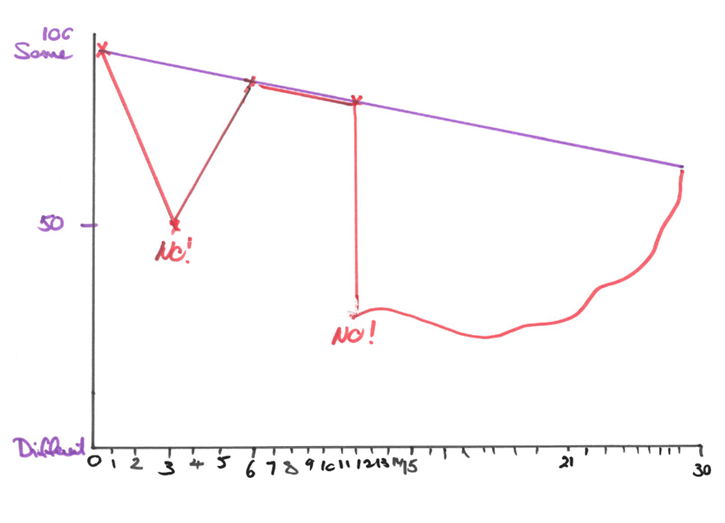
Sometimes it is helpful to connect this information to a broader explanation about child development, individuation, and mature separation from the family of origin. This explanation integrates with the Bower Place analysis of development of mature identity which is described in another paper. Using a developmental lens and the attached diagram one can explain to parents the expected trajectory from infancy to fully formed adult identity. As an infant the child has no choice but to be the same as the parent because the parent dictates everything the child does. However, at two or three years old when the child begins to realise, they are a separate being and asserts their individuality difference begins to appear, most notably as the tantrums of the ‘’terrible twos or terrible threes’’. The child’s favourite word becomes ‘’no’’ as they insist on what they will wear, eat and do often much to the distress of the parent. This phase passes and there is relative harmony and a return to greater sameness between parent and child. However, this phase is essential as it is part of the processes of differentiation dictated by the culture and circumstance of the family that is preparing the child to, one day, be independent. With adolescence the struggle returns to the relationship as the young person once again explores the question of ‘Who am I, different from you?’ as they did at two. Difference rather than sameness becomes the hallmark of the relationship. The resolution of this struggle to establish a mature adult identity sometime between 25 and 35 will see more sameness than difference between the child and their parents in terms of fundamental values and a return to a more peaceful relationship.
Parent/Child Similarity & Difference – Conflict and Differentiation
Why is this useful in therapy?
This construction can be helpful in several respects. It ties the current struggle which has resulted in a narrow focus on specific behavioural issues between parent and child into a broader and less personal developmental frame and evokes the initial attachment relationship which most parents can trust. It also reminds them of a previous similar time of difference between themselves and their child which successfully resolved back into greater congruence. Implicitly the practitioner suggests this will happen again with their child more like than different from them when this phase is resolved. In accepting this, parents can ’give up the struggle’ which is fuelling escalations and in doing so allow their child’s mature identity to evolve.
References
Biddle, B., Bank, B., and Marlin, M. Parental and Peer Influence on Adolescents Social Forces, Jun. 1980, Vol. 58, No. 4 (Jun. 1980), pp. 1057-1079
Lee, C., Padilla-Walker, L. and Memmott-Elison, M., The role of parents and peers on adolescents’ prosocial behavior and substance use Journal of Social and Personal Relationships 2017, Vol. 34(7) 1053–1069
Hoellger, C., Sabrina Sommer, S., Albert, I., and Buhl, H.,1 Intergenerational Value Similarity in Adulthood Journal of Family Issues 2021, Vol. 42(6) 1234–1257